

How Do You Get Your House Put On National Historic Register

The National Annals of Celebrated Places is the official listing of backdrop that are considered worthy of preservation. The register began in 1966 afterwards the National Historic Preservation Act was passed. It's currently overseen past the National Parks Service and at present lists more than 90,000 properties.
The goal of the National Register of Historic Places is to put together and provide support for individual and public efforts to protect, evaluate and place historical and archaeological resources in the U.Due south. Although the Register is a national list, the process of putting a property on the register typically starts at the state level.
This guide will tell you everything you lot demand to virtually National Annals eligibility and criteria.
Contact U.s. Today
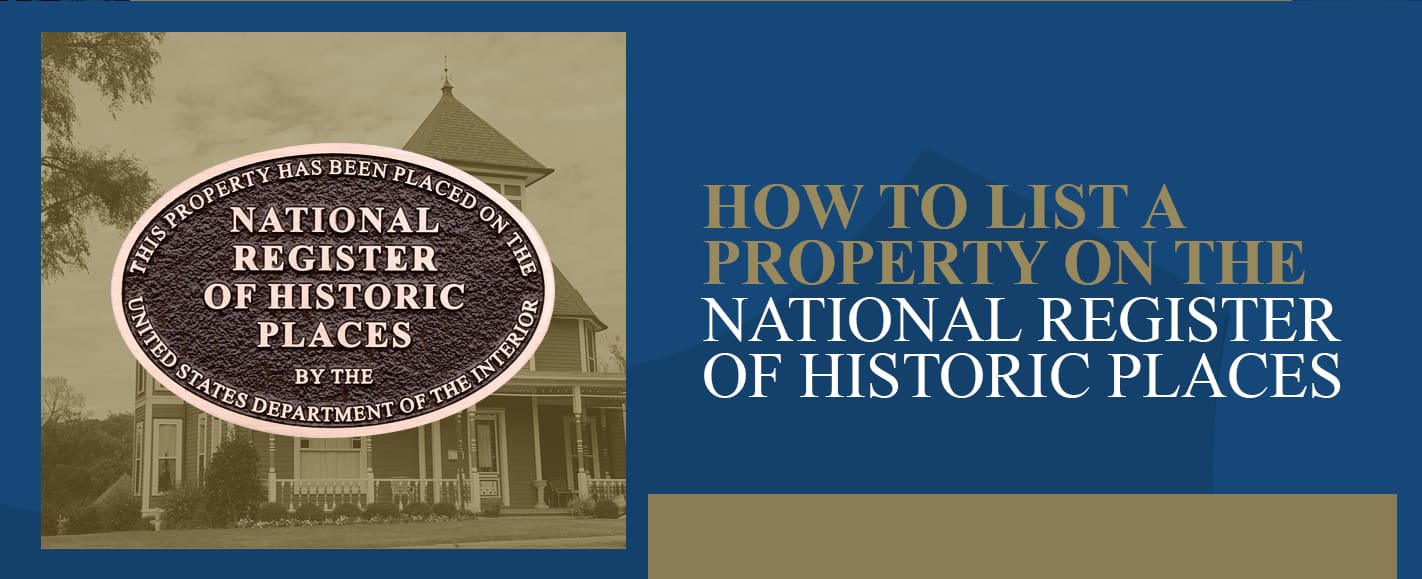
How to List a Property on the National Register of Historic Places
The kickoff step to accept if yous want to list your property on the National Register of Celebrated Places is to get into bear on with your State Historic Preservation Role (SHPO). If your property is located on tribal land, yous'll want to go far bear on with the appropriate Tribal Preservation Office. If the property is on federal land, you'll need to reach out to the Federal Preservation Office.
Although the nomination process might vary from country to state, you tin generally expect your SHPO to evaluate and survey the belongings later y'all've submitted the appropriate application materials. Your SHPO will let you know what documentation you need to provide with your application too as the criteria information technology volition utilise to evaluate your belongings.
Here'south how to make it bear on with the SHPO in each state:
The Procedure of Listing Your Belongings on the National Register of Celebrated Places
You don't take to own the property to nominate it for inclusion on the National Annals of Historic Places. Preservation societies, government agencies and historical societies are just a few of the organizations that can nominate a holding. In one case an SHPO receives a nomination, it will let the holding owner know most it. The SHPO will also let the local government know well-nigh the nomination. After that, there'south a menses when people are invited to comment on the nomination. If the owner isn't the one to submit the nomination, they practise have the right to object to it.
One time the comment period is over, the SHPO and the National Register Review Board in the state volition review the nomination. The review process takes at least 90 days, although the verbal length can vary from state to country. If the property passes the initial review, it gets submitted to the National Park Service for final review. The park service has 45 days to make its decision to list the property or non.
Why Listing a Property on the National Register of Historic Places?
Why get to the trouble of list your belongings on the National Register? There are a few benefits of owning a registered celebrated place.
All properties that are on the Register are included in the National Register Archives, which is a public database that contains data and, in some cases, photos of each registered identify. Listing backdrop on the National Annals too provides documentation of the property'south significance and importance from a historical perspective and can assistance to encourage farther preservation of historic resource.
In that location are also financial advantages to list a property on the National Register. Some states provide grant funding and tax incentives to owners of historic properties. Federal grants and tax credits are also available in some cases.
Owning a property that's on the National Annals of Historic Places also gives you bragging rights. Yous can put up a bronze plaque that lets everyone know that the property is on the register. You also have the take chances to mix and mingle with other owners of historic properties, through in-person meetings or online, besides equally the opportunity to get information on the best ways to intendance for and preserve your belongings from the National Park Service.
National Register of Historic Places Criteria
Not every property is eligible for placement on the National Annals of Historic Places. Generally speaking, a property will be evaluated based on the quality of its significance to culture, architecture, archaeology, engineering and history in America too as based on the workmanship, materials, setting, design and location of the belongings. Properties can exist structures, buildings, entire districts, specific sites or other objects.
To qualify for placement on the National Annals, a property needs to meet at to the lowest degree one of the post-obit four criteria:
- Association with events that accept contributed significantly to history.
- Association with the life of a significant person.
- An embodiment of distinct characteristics of a particular catamenia, type of architecture or structure method.
- Able to provide important historical information.
When it comes to how sometime a property needs to be to make it to the National Register, age is more than just a number. The National Register guidelines state that by and large speaking, a belongings needs to be at least 50 years erstwhile for inclusion on the list. There are exceptions, though. If a holding has been around for less than 50 years only has achieved significance in that period, it might be eligible for inclusion.
It'due south besides worth noting that some properties are typically excluded from the National Register, such as birthplaces, gravesites, structures that have been moved and religious institutions. Simply, there are exceptions to the dominion, and some usually excluded backdrop might be added to the Register if any of the following applies:
- The holding has meaning historical, architectural or creative value or importance.
- The grave or birthplace belongs to an important historical figure who doesn't have a building or site connected to their productive life.
- The cemetery houses the graves of incredibly of import people, has a connexion to historical events or has distinctive pattern features.
- The structure or building was moved but has significant architectural value or is continued to an of import historical event or person.
- The building was rebuilt as office of a restoration plan, and no other similar building or construction has survived.
Order a National Register Plaque
How to Utilize National Annals Criteria to Your Property

The National Annals is meant for tangible, concrete backdrop that have a location that is generally fixed. Part of determining whether or not your property meets National Annals eligibility requirements involves determining what category your holding belongs in. The National Register uses 5 categories to classify properties:
- Building: A building is typically any structure that provides shelter for a homo activity. Homes, libraries, theaters, hotels and train stations are all examples of backdrop that belong in the building category. To be eligible for placement on the National Annals as a edifice, a property needs to take all of its structural elements. Otherwise, it can be considered a ruin and would cease upwards in the "site" category.
- Structure: A structure is a structure that has a function and a purpose that is anything other than providing shelter to humans. Lighthouses, trolley cars, bridges, silos and windmills are all examples of properties that autumn into the construction category.
- Object: An object is normally a small structure that serves an artistic purpose. Objects tin be moveable merely are usually associated with a specific identify or setting. Statues, fountains, monuments and purlieus markers are examples of objects.
- Site: A site is the location of a particular celebrated or pre-historic issue. To qualify for the annals, the site does non demand to accept any remains or show of the issue, specially if it is an event that dates back to prehistoric times. Examples of a site include a battleground, rock shelter, shipwreck, trail, hamlet site or campsite.
- District: A historic district typically has a concentration of the other four categories that are all linked together by history or by a particular aesthetic style. It needs to have a defined geographical expanse and significance regarding history, archaeology, architecture, engineering or culture. Examples of a commune include a business commune, rural areas, higher campus, transportation systems and culvert systems.
Understand the Historical Context of the Belongings
What constitutes a historic home? To brand it to the National Register, a holding needs to exist more than just old. It also needs to have played some role in defining its community during the flow when it was constructed. Determining the historical context of a property is both a subjective and objective process. The National Parks Service looks at five things to determine historical context and the property's significance. Those factors are:
- The historical or prehistoric facet of the area that the holding represents.
- Whether the facet is significant.
- Whether the belongings is important or relevant when illustrating the context.
- How the belongings illustrates history.
- Whether the property has features that convey the attribute of history or prehistory that it's associated with.
The historical or prehistorical facet tin can be anything from association with an important person to a major event in the surface area. It tin can also be a particular style of architecture, archaeology or applied science that was developed during the menstruum.
The significance of the property tin be evaluated past looking at whether or not the historical context or other facet played an essential role in the evolution of American history or the development of a particular area. For instance, a battlefield that was the site of a major event during the Civil War has historical significance. The house where Mark Twain wrote his novels can have historical significance besides. A structure that was the first construction built by Frank Lloyd Wright likewise has significance.
In some cases, the context of a historic holding can be determined by its geographical location. For example, a building that might seem historically insignificant when looked at through a national lens might take considerable historical significance to a local community or boondocks. A property can as well exist viewed in the context of the role it played in the development of a land's history, even if the significance seems limited to a particular surface area of the state.
National Annals of Celebrated Places Criteria for Evaluation
To qualify for placement on the National Register of Historic Places, a property typically has to be associated with an event, person or blueprint that has some historical significance, or else it needs to provide some information well-nigh history. How tin a belongings do that? Take a closer look at what makes a holding historically significant in each of the four criteria.
1. Upshot
A holding that is associated with at to the lowest degree one event that made a significant contribution to history may exist eligible for the National Register. The process of evaluating a belongings involves looking at its origin and nature as well as at its association with a particular consequence and the historical context of that event. For example, a property tin have played a part in the settling or foundation of a town or the development of the economy of a port urban center. Other examples of properties connected to events include:
- The building where an important invention was created.
- The site of a boxing.
- The trail people followed when moving across the state or exploring.
- A factory district that played a part in the evolution of a urban center'south economy or where an of import labor event took place.
2. Person
A property that is associated with the life a significant historical person can likewise be listed on the National Register. The holding tin can be the habitation the person lived in, the studio where they created artworks or recorded music, or the office location of the concern they founded. The person needs to accept been a significant figure — for case, the mansion where a Rockefeller or DuPont lived can authorize every bit a historic place, while the abode a relatively unknown doctor or lawyer won't.
3. Design or Construction
Backdrop that showcase certain distinct characteristics of a design period or manner, a method of structure, that are the piece of work of a principal or that have a high artistic value might exist eligible for placement on the National Register. A belongings tin can be looked at as the sum of its parts even if its components lack particular distinction. Examples of backdrop that tin brand information technology to the Register because of their blueprint or structure include:
- A house or building that represents a pregnant mode of architecture.
- Park or garden that is designed under the auspices of a detail landscape pattern philosophy.
- A theater with decorative features that display a loftier creative value, such as an Fine art Deco theater.
- A dam that was created using technologically avant-garde construction methods.
four. Data Potential
In some cases, a property can be listed on the National Register of Celebrated Places not because it is connected to a significant individual or is an example of a significant style or work of fine art, but because it can provide information about human history. To qualify every bit a celebrated place under the information potential criterion, a property needs to take information that contributes to the understanding of history or prehistory and the information it can provide needs to be considered important.
The most common type of property that is nominated using the information potential criterion is an archaeological site, although individual buildings, structures or objects can as well be eligible.
Historical Integrity of Property
A historic holding not only needs to have historical significance. It also needs to have historical integrity. Determining whether or non a property has historical integrity is often the virtually subjective part of deciding whether or not it belongs on the National Register. That said, there is however an objective component to the assessment based on several aspects of the belongings. Those aspects are:
- Location: Location can refer to the place where the property was built or the location of a particular event, such as a battle. The connexion between the belongings and location can often provide a clue every bit to why an event occurred or why it was pregnant. An example of location is a battlefield.
- Design: Design refers to the elements of the property that create its style, form, space and structure. Design comes about as a result of decisions made past the creator or planner of the holding. It reflects the technologies of the time, too as the artful preferences of the fourth dimension. An example of blueprint is an Art Deco theater.
- Setting: Setting isn't the same equally location. While location refers to place, setting focuses on the elements that surround the place. Examples of setting include whether is a stream nearby or a human-fabricated lake, whether the property is located at the acme of a hill or in the lesser of a valley.
- Materials: Materials refer to what was used to make the property and how they are joined together. Usually, materials reflect the technology of the fourth dimension. For example, a historic dwelling house from the Colonial catamenia is likely to have a facade made of brick.
- Workmanship: Workmanship refers to the skill used in putting together the property too as to the methods preferred during the time it was synthetic. Examples include the way materials are joined together, the style a building is painted or the details are carved into wood.
- Feeling: Feeling refers to the property's ability to express its historic sense or aesthetic. It's the combination of physical features that come together to display the historic character of the property. An example is a group of celebrated rowhouses in the eye of a busy metropolis that manage to create a sense of what life was similar in the Colonial era.
- Clan: Association refers to the connection between the property and a celebrated person or event. An instance is a Ceremonious State of war campground that maintains many of the same elements it had when soldiers camped at that place during the war.
Become a Historical Plaque From Erie Landmark
If your property meets the requirements for the National Register of Historic Places, you can display a plaque letting passersby and visitors know of its status. Once your property is listed on the Annals, Erie Landmark Company can produce a plaque to display on your property. We offer standard National Register plaques as well customized National Historic plaques. Contact a member of our team to larn more about how we tin create a plaque that'due south worthy of your historic property.

Source: https://www.erielandmark.com/how-to-list-a-property-on-the-national-register/
Posted by: hughesconsel.blogspot.com
0 Response to "How Do You Get Your House Put On National Historic Register"
Post a Comment